Friday, 12 July 2013

Hedgerows In Bloom.


                                                                        Hedgerows Are Blooming.

Our hedgerows are in full bloom with a mass of our native wild flowers. On my trip out to the countryside this weekend I could not help but notice all the different colours that were in the hedgerows at the present moment. There were the White flowers of the Blackberry ( Rubus fruitcosa. ) also known as the Bramble bush, Honeysuckle ( Lonicera. ) with their highly perfumed flowers in various shades of colours, White, Cream, Yellow and deep Purple. There was also our beautiful native wild Rose ( Rosa canina. ) the Dog Rose with it's Pink and White flowers. The flowers of the Elder Tree ( Sambucus. ) pretty lace like flower heads poking out through the hedgerow or standing tall above it. These are the main plants that could be seen but there are still other hedgerow plants in flower like the Foxglove, White and Pink Campion and I also spotted a Nettle Leaved Campanula growing in one place at the side of the road in a local hedgerow.

                                                                               The Bramble.

Bramble Bush.
Close Up Of Flower.
The Fruit.
( Blackberries. )

The Bramble Bush grows wild around our woodlands and in our hedgerows sending up its long arching canes that do not flower or set fruit in their first year. In their second year they produce flowers and fruit. The bush starts to flower in May and continues through to late summer. The fruits start to form July onwards and are at their best in late August and September. The flowers attract many bees and butterflies of which some are dependent on for their survival and hover flies. The fruit is also eaten by several species of birds particularly the Blackbird. The fruit is also eaten by a large number of mammals such as the Fox, Mice and others. The cane of the bush ( Bramble Stems ) when cut and dried, then split were used as a binding material for tying straw in basket work and was once used for making the traditional bee skips as used by many bee keepers in the past. The fruit also has many culinary uses such as making Blackberry Pie on its own or Blackberry and Apple. The fruit is also used for making jams, jelly and in the making of wine and brandy.

                                                                        Blackberry Brandy.

Here is a old recipe for making Blackberry Brandy.

Recipe.

1 Bottle of Brandy.
Enough blackberries to fill half a bottle.
A few Cloves 3 or 4.
Cinnamon to taste.
90 grams of Sugar.
1 Clean and sterilised glass bottle with a screw top.

The Method.

Crush the berries  lightly in a glass bowl.
Half fill your sterilised bottle with the crushed fruit.
Add the Cinnamon, cloves and sugar and fill with brandy.
Screw down the top tightly on bottle and leave for 3 or 4 months.
Shake the bottle everyday for the first 2 weeks and then once a month.
After 3 or 4 months or when clear strain into another bottle and enjoy.


                                                                             Honeysuckle.

The Honeysuckle ( Lonicera ) or sometimes also called Woodbine, is also an arching shrub or a twining vine in the family Caprifoliaceae. Most species are very sweetly scented and produce a sweet and edible nectar. The fruits are red, blue or black and are mildly poisonous so most fruits are only attractive to wildlife. There are 180 species of this plant worldwide with most of them being found in China, India, North America and Europe. The plant is valued in our gardens for its ability to quickly cover unsightly walls, fences and outbuildings and for its fragrance. Stick dressers look for Hazel, Holly and Ash that have been used by the honeysuckle to climb up because of the markings left by the plant, as it twists and climbs up the tree, always in a Clockwise Direction. The flowers attract butterflies, moths and other insects and the berries are loved by the birds. One moth in particular that is attracted to the flowers is the Humming Bird Hawk Moth, Macroglossum Stellatarum.


                  The Humming Bird
                          Hawkmoth.


Honeysuckle.


Close up of flower.


                                                                                 Wild Rose.


The Dog Rose ( Rosa canina ) our native wild rose with its pink or white flowers is sprawling through our hedgerows filling them with colour. The plant may have got its common name the dog rose from its use during the eighteenth and early nineteenth centuries when it was used to treat the bite from a rabid dog. The other explanation for its name is the term "dog'  which was used to describe something that was 'worthless; presumably by its comparison to cultivated roses. The plant is very high in certain antioxidants, the fruit is noted for its high vitamin C levels and was used to make Rose Hip Syrup and also tea and marmalade. Rose Hip Syrup is made from the hips that the plant produces after it has finished flowering and it was used extensively for the production of vitamin C during the war period. The fine hairs found inside the hips were very popular with children who would use them for making itching powder.


The Dog Rose found in many of our hedgerows.


Close up of flower.
Close up of flower.


Rose Hips.

                                                                             The Elder Tree.

The Elder ( Sambucus ) was once regarded as one of the most magically powerful of all plants with many myths and folklore attached to it. It is a broadleaved tree and it is deciduous. It will grow in almost any soil except sand and it is native to the British Isles and can be found growing in many gardens, hedgerows and woodlands. The elder has many uses, for food and drink. Elderflower cordial makes a lovely refreshing drink on a hot summers day, 'champagne' can also be made from its flowers. The berries are used to make a delicious rich red wine. The flowers are also used to make a skin cleanser and a eye lotion by the cosmetic industry.
Elder in flower.
It is thought that it got its name from the Anglo-saxon word 'aeld ' meaning fire because the stems, when hollowed out were used to blow air down them into the centre of a fire like bellows. There is a lot of folklore and magical references made about the tree. It was thought that if you burned elder wood you could see the devil in the smoke and flames. If you planted one near to your house it would ward of the devil and other evil spirits. It was also said that the Fairy people who love music and merrymaking love the sound produced by instruments made from elder wood. The wood from elder is used to make whistles, pipes, chanters and other musical instruments, due to the branches containing a soft pithy core that is easily removed to create a hollow pipe of a pale, hard, easily polished wood ( it also makes good pea shooters ). It is said that the best time to catch or see a fairy is under the tree on Midsummer's Eve, when the fairy King and Queen could be seen passing by. The elder has many medicinal uses, its leaves are believed to have mildy narcotic influences which is why in old folklore superstition you were advised never to fall asleep under an elder tree in case you never woke up again. The aroma exuded by the leaves will repel flies, bunches of leaves were hung in the doorways of homes, livestock barns, in dairies to stop the milk from turning and a sprig of leaves was often employed to keep flies away from a horses head by tying it to its harness. The berries, leaves and the bark were used in the Harris Tweed industry. All dyes used came from the elder.
Elder berries.
                                                                          The Dog Wood.
                                                                        ( Cornus florida. )

This was quite a surprise finding this beautiful shrub growing in one of our local hedgerows. It can not be seen from the road as it is on a private estate where I had been given permission to take some photos of it. This is not a native plant, of which there are about 30 - 60 species found around the world and most of them are found in North America, China, Japan and the Southeastern United States is particularly rich in native species. The name 'dog tree' entered the English vocabulary in around 1548 by 1614 it had been changed to 'dogwood' it was also called the Hounds Tree in some parts of the country. It is thought that it got its name from using the slender stems for making "dags' ( daggers, skewers and arrows ). Another name for this tree is the Whipple tree. A whippletree is part of the harness in horse-drawn carts it was used to link the draw pole of the cart to the harness of the horses in file, these items still bear the name of the tree from which they were made.
A Whippletree for a three horse team.

Like the Dogrose it is high in vitamin C but it was seldom used in medicine. The timber of dogwood was highly prized for making loom shuttles, tool handles, roller skates, longbows, heads of golf clubs and as fine inlays and the very first kinds of laminated tennis rackets were also made from the wood after it had been cut in to thin strips.
Full length is about 50 yds.
The Hedge.


Close up of the flower.

Sunday, 7 July 2013

Making Hay.


                                                                         Farmer's Make Hay.

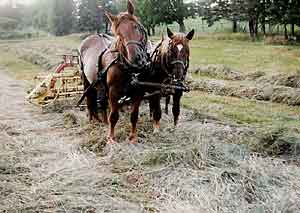
The Old Way.

The art of Hay Making is the longest known method of conserving grass for winter stock feeding and man has been making it for the last six thousand years. This month see's the start of the hay making season and with this sudden hot spell, farmers all over the country are Making Hay While The Sun Shines, to quote an old saying.

To make hay successfully farmers are dependant on the weather as once the grass is cut it has to be throughly dried before it can be bailed and stored. Cutting usually takes place from mid June and onwards if the weather permits, just before the grasses and other plants start to flower however , many meadows are cut whilst in flower when there is a lot of pollen being produced by the plants ( hence Hay Fever ).


                                                                    Traditional Hay Meadows.


Cutting The Grass.

After Cutting.


When the weather looks to be settled for a period of several days or more the Hay Making Process can begin. Once the sun has burnt off the early morning due hay cutting begins, the mowers cut the grass leaving it in neat rows, to begin the drying out process. To help the crop to dry out the farmer will use an attachment that lifts and roughs up the cut rows of grass to allow the air in and enable it to dry out quicker in the sun, as much moisture as possible needs to be removed before baling the hay can take place and all this is a race against time, if the weather changes and it rains on the grass then the crop is lost.


                                                   Two Different Types Of Hay Turning Attachments.


Here we have a sequence of photos showing how it was done in the olden days and in some parts of the world, this is still how it is done today.


Cutting The Grass.
Turning It In To Rows.


Horse Drawn Mower.
A Horse Drawn Rake.


Carting It Away.

Once the grass has completely dried out which could take a few days or more then the process of bailing it begins. If the moisture content is to high at this point and the bales are put in to store then there is a high risk of the bales spontaneously combusting ( self igniting ).


                                                                        Balers Old And New.

At the mowing stage the grasses can contain up to 90% of their moisture, this will have to be reduced to between 12% and 20% before it can be safely stored. The use of modern equipment started as recently as only 50 years ago with the first modern bailer being made by John Deere in the United States of America. Before the introduction of modern farming equipment the Hay Harvest was almost a community event, labourers from neighbouring farms would all get together to help get this important crop in as quickly as possible, so it was all hands on deck with some of the local villagers and even school children helping out as it was very labour orientated to cut, rake, turn over and cart it away.

I have only touched briefly on this subject to give you a little insight, many books full of advice have been written over many years but the process it's self has changed little.


Friday, 5 July 2013

Facts About The Month Of July.


FACTS ABOUT THE MONTH OF JULY.

Gemstone; Pearl


Delphiniums.
Flower of the month:
Larkspur ( Delphinium )


July is the Seventh month of the year according to the Gregorian Calendar and is also one of the hottest. It is nearly the end of the school year and the start of the summer holiday season. July was the fifth month of the year in the calendar of the ancient romans and was called Quintilius which means fifth. It was later changed by a Roman Senate to Julius in honour of Julius Caesar who was born in the year 100 BC on the 12th of July and he died on March 15th in 44 BC.

The Anglo-Saxon names for this month were Heymonath and Maed monath meaning the month of haymaking ( Heymonath ) and this was the time of the month when all the flowers were in full bloom in the meadows ( Maed Monath )


Weather-lore, Beliefs and Sayings.


'If the first of July it be rainy weather,
'Twill rain more or less for four weeks together'.


On St Swithin's Day the 15th of July it was said that whatever the weather is like on this day it will continue so for the next forty days and nights.

St Swithin's Day, if thou dost rain
For forty days and nights it will remain.
St Swithin's Day, if thou be fair,
For forty days and nights t'will rain nae mair.

Statue of Saint Swithin.
Festivals and Traditions.

Since the year of 1839 during the month of July the Henley Royal Regatta has taken place each year on the River Thames at Henly-on-Thames in Oxfordshire. The regatta lasts for 5 days and there are over 200 races taking place. The regatta was given its royal status after the visit by H.R.H Prince Albert in 1851 who was the first Royal Patron to attend the regatta. Since the death of The Prince Consort the reigning Monarch has always consented to become its patron. This patronage means the Regatta can be called The Henley Royal Regatta.


Grandstand View.
The Fawley Bar.


Kingston R.C. "A"
vs
Derby R.C.
Floating Spectators.


Also this month the annual Swan Upping takes place. This is the when the census of the the swans along a 70 mile stretch of the River Thames over a 5 day period is carried out. Each swan caught by the Uppers is counted and marked.


Swan Upping.

Honiton Fair in Devon, an event lasting three days, begins on the first Tuesday after July the 19th each year. The fair has been held on St Margaret's Eve since 1221 and is one of the few fairs that preserves the ancient 'Glove is up' custom. The fair begins with the Town Crier carrying a 12 foot pole covered with flowers and on it's top is a gilded glove and he then recites to the town:

Oyez, Oyez, Oyez
The glove is up
The fair has begun
No man shall be arrested until the glove is taken down.
God save the Queen.

Hot coppers are then thrown down into the street from an upstairs window of the Angel Hotel to be picked up by the people of the town. This whole process is repeated again later on in the week at the White Lion where the Glove is taken down signifying the end of the fair.

St James' Day or Grotto Day is on July the 25th. On this day children used to make grottoes and caves and decorate them with sea shells because the shell of the Scallop is supposed to look like the emblem of St James' . The grottoes were placed outside their homes and the children would sit by them and recite this verse:

Please remember the Grotto.
It's only once a year.
Farther's gone to sea.
Mother's gone to bring him back.
So please remember me.


Emblem of Saint James.

Scallop Shells.


Other Notable Dates.

July 1st. In 1837 the registration began of all birth's, marriage's and death's.
In 1937 the introduction of the 999 emergency service began.
In 1997 the British rule of Hong Kong ended after 99 years.

July 3rd On this day in 1938 'The Mallard' broke the record for steam engines after reaching a speed
of 126 mph.

July 12th In 1690 The battle of the Boyne took place in Northern Ireland, although the battle took
place on the 1st of July today is the commemoration date.

July 13th National Day – Northern Ireland.

July 15th St Swithin’s' Day.

July 21st Apollo 11 landed on the moon.

July 25th St James' Day Patron saint of pilgrims.
The Whistable Oyster Festival.
St Christopher's Day Patron saint of travellers.
.

Friday, 21 June 2013

Wild Flowers.

                                                                      Wild Flowers.


Wild Flowers have been very much in the news in recent times and if you have seen or heard the reports in the press and on the Radio or the TV you will have some idea of their importance and how the loss of them is causing concern.
Since the end of the first world war modern agricultural methods started to see the decline of our natural hay meadows and as the threat of a second world war became apparent the government told all the country's farmers that they must grow more food because a lot of our food was imported from other parts of the world and we could no longer rely on those supplies reaching us. This became the start of the loss of thousands of acres of farmland that were once our traditional hay meadows. The importance of these wild flower meadows are the loss of the habitat that they created for the birds, bees, butterflies and insects as well as the loss of what was once a rich, colourful and diverse habitat for many forms of wildlife.

                                                                    The Good News.


Many organisations are putting pressure on the government to help reinstate as many areas as possible as Wild Flower Meadows.
The Wild Flowers help to capture astonishing amounts of carbon.
They can help and improve the quality and fertility of the soil.
Some provide us with medicines and remedies that help to heal us.
They can help protect our shorelines, regulate water flow and prevent flooding.
And they are aesthetic and beautiful to look at.

                                                                    The Bad News.

Every county in the UK is losing, on average, one species of wild flower plants every two years.
Every county in the UK has lost many of its Wild Flower Meadows, Staffordshire has lost more than 65% of its meadows, Worcestershire 75% and Derbyshire 51%.


                                                                    The Foxglove.

Of all the wild flower plants that I could have chosen to write about for this article, I have chosen the Foxglove. This plant is one of the most important species of wild flowers that could soon be on the danger list.
The common Foxglove ( Digitalis purpurea ) comes in to flower during the month of June, it was said that bad fairies gave the bell-shaped flowers to foxes to wear on their paws as gloves so that they could silently creep up on chickens to catch them, hence its name foxglove. They can still be found growing in our countryside in woodlands and in the hedgerows around the fields. The seeds can remain dormant in the soil for many years waiting for the right conditions to make them spring into life. The foxglove is a biennial plant, that is to say that in its first year it only produces a clump of leaves but in its second year it sends up a long stem covered in beautiful pink-purple flowers. This plant is totally dependent on our Bumblebee for its survival, its blooms have evolved to be attractive to the bumblebee which lands on the large bottom lip of the flower and then follows the spots on the inside, which leads them to the nectar.


A Bumblebee landing on a Foxglove.
The bumblebee is the only insect that can pollinate the foxglove as the reproductive parts of the plant are situated in the roof of the flower, and because the bumblebee is a large insect, it has to push its way in to reach the nectar. In doing so, it rubs its back against the pollen covered stamen thus pollinating each plant as it fly's from one to the other.
Without this interaction between the bumblebee and the foxglove, the foxglove would die out and without wild flowers the bumblebee and many other insects including butterflies and bees will also become extinct. The foxglove has also insured itself against bad weather during its flowering period. The blooms start to open from the bottom of the plant first, slowly moving up the stem so that it takes several weeks for the flowers at the top of the stem to finally open. This ensures that if the weather is particularly bad and there are not many bumblebees around to pollinate the plant, there will still be flowers open to pollinate if and when the conditions improve.

                                                              Wild Flower Seed.

If after reading this article you would like to create a wild flower area then for one of the largest suppliers of seed go to Hurrells web site; www.wickedwildflowers.co.uk. Here you will be able to see what seeds are available and read about the habitat each plant requires to survive.