Sunday, 7 July 2013

Making Hay.


                                                                         Farmer's Make Hay.

The Old Way.

The art of Hay Making is the longest known method of conserving grass for winter stock feeding and man has been making it for the last six thousand years. This month see's the start of the hay making season and with this sudden hot spell, farmers all over the country are Making Hay While The Sun Shines, to quote an old saying.

To make hay successfully farmers are dependant on the weather as once the grass is cut it has to be throughly dried before it can be bailed and stored. Cutting usually takes place from mid June and onwards if the weather permits, just before the grasses and other plants start to flower however , many meadows are cut whilst in flower when there is a lot of pollen being produced by the plants ( hence Hay Fever ).


                                                                    Traditional Hay Meadows.


Cutting The Grass.

After Cutting.


When the weather looks to be settled for a period of several days or more the Hay Making Process can begin. Once the sun has burnt off the early morning due hay cutting begins, the mowers cut the grass leaving it in neat rows, to begin the drying out process. To help the crop to dry out the farmer will use an attachment that lifts and roughs up the cut rows of grass to allow the air in and enable it to dry out quicker in the sun, as much moisture as possible needs to be removed before baling the hay can take place and all this is a race against time, if the weather changes and it rains on the grass then the crop is lost.


                                                   Two Different Types Of Hay Turning Attachments.


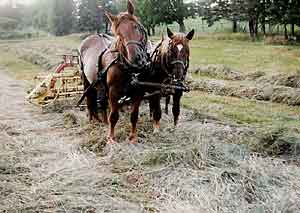
Here we have a sequence of photos showing how it was done in the olden days and in some parts of the world, this is still how it is done today.


Cutting The Grass.
Turning It In To Rows.


Horse Drawn Mower.
A Horse Drawn Rake.


Carting It Away.

Once the grass has completely dried out which could take a few days or more then the process of bailing it begins. If the moisture content is to high at this point and the bales are put in to store then there is a high risk of the bales spontaneously combusting ( self igniting ).


                                                                        Balers Old And New.

At the mowing stage the grasses can contain up to 90% of their moisture, this will have to be reduced to between 12% and 20% before it can be safely stored. The use of modern equipment started as recently as only 50 years ago with the first modern bailer being made by John Deere in the United States of America. Before the introduction of modern farming equipment the Hay Harvest was almost a community event, labourers from neighbouring farms would all get together to help get this important crop in as quickly as possible, so it was all hands on deck with some of the local villagers and even school children helping out as it was very labour orientated to cut, rake, turn over and cart it away.

I have only touched briefly on this subject to give you a little insight, many books full of advice have been written over many years but the process it's self has changed little.


Friday, 5 July 2013

Facts About The Month Of July.


FACTS ABOUT THE MONTH OF JULY.

Gemstone; Pearl


Delphiniums.
Flower of the month:
Larkspur ( Delphinium )


July is the Seventh month of the year according to the Gregorian Calendar and is also one of the hottest. It is nearly the end of the school year and the start of the summer holiday season. July was the fifth month of the year in the calendar of the ancient romans and was called Quintilius which means fifth. It was later changed by a Roman Senate to Julius in honour of Julius Caesar who was born in the year 100 BC on the 12th of July and he died on March 15th in 44 BC.

The Anglo-Saxon names for this month were Heymonath and Maed monath meaning the month of haymaking ( Heymonath ) and this was the time of the month when all the flowers were in full bloom in the meadows ( Maed Monath )


Weather-lore, Beliefs and Sayings.


'If the first of July it be rainy weather,
'Twill rain more or less for four weeks together'.


On St Swithin's Day the 15th of July it was said that whatever the weather is like on this day it will continue so for the next forty days and nights.

St Swithin's Day, if thou dost rain
For forty days and nights it will remain.
St Swithin's Day, if thou be fair,
For forty days and nights t'will rain nae mair.

Statue of Saint Swithin.
Festivals and Traditions.

Since the year of 1839 during the month of July the Henley Royal Regatta has taken place each year on the River Thames at Henly-on-Thames in Oxfordshire. The regatta lasts for 5 days and there are over 200 races taking place. The regatta was given its royal status after the visit by H.R.H Prince Albert in 1851 who was the first Royal Patron to attend the regatta. Since the death of The Prince Consort the reigning Monarch has always consented to become its patron. This patronage means the Regatta can be called The Henley Royal Regatta.


Grandstand View.
The Fawley Bar.


Kingston R.C. "A"
vs
Derby R.C.
Floating Spectators.


Also this month the annual Swan Upping takes place. This is the when the census of the the swans along a 70 mile stretch of the River Thames over a 5 day period is carried out. Each swan caught by the Uppers is counted and marked.


Swan Upping.

Honiton Fair in Devon, an event lasting three days, begins on the first Tuesday after July the 19th each year. The fair has been held on St Margaret's Eve since 1221 and is one of the few fairs that preserves the ancient 'Glove is up' custom. The fair begins with the Town Crier carrying a 12 foot pole covered with flowers and on it's top is a gilded glove and he then recites to the town:

Oyez, Oyez, Oyez
The glove is up
The fair has begun
No man shall be arrested until the glove is taken down.
God save the Queen.

Hot coppers are then thrown down into the street from an upstairs window of the Angel Hotel to be picked up by the people of the town. This whole process is repeated again later on in the week at the White Lion where the Glove is taken down signifying the end of the fair.

St James' Day or Grotto Day is on July the 25th. On this day children used to make grottoes and caves and decorate them with sea shells because the shell of the Scallop is supposed to look like the emblem of St James' . The grottoes were placed outside their homes and the children would sit by them and recite this verse:

Please remember the Grotto.
It's only once a year.
Farther's gone to sea.
Mother's gone to bring him back.
So please remember me.


Emblem of Saint James.

Scallop Shells.


Other Notable Dates.

July 1st. In 1837 the registration began of all birth's, marriage's and death's.
In 1937 the introduction of the 999 emergency service began.
In 1997 the British rule of Hong Kong ended after 99 years.

July 3rd On this day in 1938 'The Mallard' broke the record for steam engines after reaching a speed
of 126 mph.

July 12th In 1690 The battle of the Boyne took place in Northern Ireland, although the battle took
place on the 1st of July today is the commemoration date.

July 13th National Day – Northern Ireland.

July 15th St Swithin’s' Day.

July 21st Apollo 11 landed on the moon.

July 25th St James' Day Patron saint of pilgrims.
The Whistable Oyster Festival.
St Christopher's Day Patron saint of travellers.
.

Friday, 21 June 2013

Wild Flowers.

                                                                      Wild Flowers.


Wild Flowers have been very much in the news in recent times and if you have seen or heard the reports in the press and on the Radio or the TV you will have some idea of their importance and how the loss of them is causing concern.
Since the end of the first world war modern agricultural methods started to see the decline of our natural hay meadows and as the threat of a second world war became apparent the government told all the country's farmers that they must grow more food because a lot of our food was imported from other parts of the world and we could no longer rely on those supplies reaching us. This became the start of the loss of thousands of acres of farmland that were once our traditional hay meadows. The importance of these wild flower meadows are the loss of the habitat that they created for the birds, bees, butterflies and insects as well as the loss of what was once a rich, colourful and diverse habitat for many forms of wildlife.

                                                                    The Good News.


Many organisations are putting pressure on the government to help reinstate as many areas as possible as Wild Flower Meadows.
The Wild Flowers help to capture astonishing amounts of carbon.
They can help and improve the quality and fertility of the soil.
Some provide us with medicines and remedies that help to heal us.
They can help protect our shorelines, regulate water flow and prevent flooding.
And they are aesthetic and beautiful to look at.

                                                                    The Bad News.

Every county in the UK is losing, on average, one species of wild flower plants every two years.
Every county in the UK has lost many of its Wild Flower Meadows, Staffordshire has lost more than 65% of its meadows, Worcestershire 75% and Derbyshire 51%.


                                                                    The Foxglove.

Of all the wild flower plants that I could have chosen to write about for this article, I have chosen the Foxglove. This plant is one of the most important species of wild flowers that could soon be on the danger list.
The common Foxglove ( Digitalis purpurea ) comes in to flower during the month of June, it was said that bad fairies gave the bell-shaped flowers to foxes to wear on their paws as gloves so that they could silently creep up on chickens to catch them, hence its name foxglove. They can still be found growing in our countryside in woodlands and in the hedgerows around the fields. The seeds can remain dormant in the soil for many years waiting for the right conditions to make them spring into life. The foxglove is a biennial plant, that is to say that in its first year it only produces a clump of leaves but in its second year it sends up a long stem covered in beautiful pink-purple flowers. This plant is totally dependent on our Bumblebee for its survival, its blooms have evolved to be attractive to the bumblebee which lands on the large bottom lip of the flower and then follows the spots on the inside, which leads them to the nectar.


A Bumblebee landing on a Foxglove.
The bumblebee is the only insect that can pollinate the foxglove as the reproductive parts of the plant are situated in the roof of the flower, and because the bumblebee is a large insect, it has to push its way in to reach the nectar. In doing so, it rubs its back against the pollen covered stamen thus pollinating each plant as it fly's from one to the other.
Without this interaction between the bumblebee and the foxglove, the foxglove would die out and without wild flowers the bumblebee and many other insects including butterflies and bees will also become extinct. The foxglove has also insured itself against bad weather during its flowering period. The blooms start to open from the bottom of the plant first, slowly moving up the stem so that it takes several weeks for the flowers at the top of the stem to finally open. This ensures that if the weather is particularly bad and there are not many bumblebees around to pollinate the plant, there will still be flowers open to pollinate if and when the conditions improve.

                                                              Wild Flower Seed.

If after reading this article you would like to create a wild flower area then for one of the largest suppliers of seed go to Hurrells web site; www.wickedwildflowers.co.uk. Here you will be able to see what seeds are available and read about the habitat each plant requires to survive.


Wednesday, 29 May 2013

A Walk In The Woods

                   
                                                                   What Are You Missing?

Like a lot of people I was out for a stroll in our local woods and in the countryside but as I walk around I often wonder just why a lot of people do this. Do they do it just to get out of the house or is it to exercise them selves or their dog or is it for something to do because it's a nice day.
The reason I ask this question is that I notice things on my walks and a lot of people that I see when on them do not seem to and to me this is one of the many pleasures that I get from my walks.

When I was out on Bank Holiday Monday my eyes and ears were looking and listening to all that was going on around me. I was looking at the wild flowers and at the birds that were flitting through the tree tops and all this makes my walk more interesting and enjoyable. I heard for the first time this year one of our summer visitors a member of the warbling family a Blackcap, I stopped to look and listen to him as he sang his heart out to attract a mate, he was perched on a branch just above my head completely ignoring me.


A Blackcap.

A little further on I saw a pair of Tree Creepers going up a tree, the male chasing the female flitting around the tree as they made their way to the top.

Tree Creeper.
On the ground my eyes were drawn to a large patch of Sweet Rudruff a pretty little white flower, it was next to some Bluebells that were still in flower. There also was both the Pink and White Campion to be seen as I walked a little further on. I then heard the Chiff Chaff singing away and also the sound of the Green Woodpecker making his laughing call as he flew through the trees nearby.

Sweet Rudruff.
A Close Up.


Pink Campion.
White Campion.


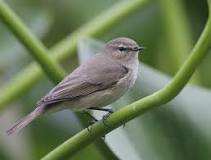
Chiff Chaff.
Great Spotted Woodpecker.
Green Woodpecker.


Shortly after hearing the Green Woodpecker I heard the drumming sound of a Great Spotted Woodpecker nearby as he was drilling into a tree with his beak, this is known as the Spring Drumming Display to attract a mate. Looking back to the ground I saw a Yellow Archangel all on it's own I could not see any others, I then found a rather unusual plant that's more at home in a garden a Welsh Poppy.


A Yellow Archangel.


Welsh Poppy.


My walk nearly over, as I was walking back to my car I saw my last bird in the wood it was a Nuthatch perched on the stump of a dead branch,  similar to the photo below.


The Nuthatch.
I wonder how many of the other walkers in the wood saw or heard as much as me. I have often been asked if there are any Deer near Burton in our local woods, the answer is yes but if you want to see them you need to be quite, move around slowly in the early hours of the morning or late evening. They are there to be seen, Marchington Woodlands has a small population of Fallow Deer and also Muntjac there are also deer around the Foremark Reservoir and Calke Abbey areas so if you want to see them invest in a pair of binoculars and a camera with a good telephoto lens.


Sunday, 26 May 2013

The May Fly


                                                                             THE MAY FLY.

Like many Trout Fisherman, I have been waiting for the May Fly hatch to take place on our local waters. The unseasonal weather seems to be delaying this annual event but it will happen quite soon.
The common name "Mayfly" is quite misleading because they can appear throughout the year. The common comes from the habit of one species, 'Ephemera danica' which normally emerges as an adult when the blossom of the Hawthorn bush is in bloom which is now.

'Ephemera danica'
The Common May Fly.
It is not just the fisherman that waits for this annual event to take place, the Trout is also waiting for it to happen so that they can gorge on them as they fall onto the water when a feeding frenzy then takes place.

A Trout Takes A Mayfly.


The life cycle of the May Fly is only a few days once it has emerged from the river bed. It begins it's life as a 'Nymph' from an egg that has been laid by an adult that has sunk down to the bottom of the river, stream or brook where it lies amongst the stones and gravel until it has incubated for a short time before it then emerges as the nymph. They remain under the water feeding on small insects and even small fish, growing on until they eventually reach maturity. When this occurs they will begin the next stage of their lives transforming from the nymph into an adult fly, floating to the surface to emerge. They then shed the 'Nymph' skin to expose their wings, once they are dry they then fly into the trees where they remain for a few days.
They tend to hatch in large numbers simultaneously, this will cause the trout to go positively bonkers and it is one of the few times when most of the fish in the water are all visibly feeding. Some fish will take them as they are making their way to the surface of the water and this is when we call them Emergers.
After two or three days the Mayflies will start to gather above the water to mate. They will start high up above the water slowly working their way down, this is when they begin the breeding cycle a ritual called the 'Spinners Fall ' " The Holy Grail of the Trout Fisherman's Life " the flies mate laying their eggs on to the water in an 'orgy'.
Once they have finished breeding they fall into the water dead their life cycle now complete. This starts off another mad frenzy as the fish go insane feeding on thousands and thousands of flies lying on the water.

The Nymph Stage.
An Artificial May Fly.
A Brown Trout.
The Life Cycle Of The May Fly.


Saturday, 25 May 2013


FACTS ABOUT THE MONTH OF JUNE  

       Gemstone; Pearl.


                                                                                    Flower; Rose.


June is the beginning of summer in the northern hemisphere, it is the 6th month of the year and it takes its name from the Roman goddess 'Juno' who was the goddess of marriage. It is for this reason that June has always been considered as the best month in the year in which to get married hence the old saying;
Married in the month of roses
Married life will be one long honeymoon.


The Anglo-Saxon name for this month was 'Sera month' meaning dry month.
The flower of the month the red rose was a symbol for love and still is, it was traditionally worn on St Georges day and Midsummer's Eve and it is to be found on the England Rugby players shirts and also on the Royal coat of arms.

The red rose became the emblem for England after the War's of the Roses, the English civil wars, that took place between the royal houses of Lancaster whose emblem was the Red rose and the royal house of York whose emblem was the White rose. The wars took place between 1455 & 1487 lasting thirty two years, the final battle took place on Bosworth Field in Leicestershire, where King Henry V11 the first Tudor monarch, defeated Richard 111 in 1485.


The Badge Of The Royal House
Of Lancaster.
The Badge Of The Royal House
Of York.


The War of the Roses saw the end of both badges and on the wedding day of Henry V11 and Catherine of Aragon the houses of York And Lancaster were joined together to create the House of Tudor.
The Tudor Rose.


                                                                          Superstitions.                                             


Midsummers Day comes after the longest day and it is a time that was associated with witches,magic and fairies. On the eve of Midsummer's Day villages all over the country would light bonfires in praise of the sun, this was because the days were becoming shorter and they believed that the sun was dying, so these large bonfires were lit to try to strengthen the sun.
 Roses were also of special importance on Midsummer's Eve because it was said that any rose picked on Midsummer's Eve or Midsummer's Day would keep fresh until Christmas.

At midnight on Midsummer's Eve, young girls would scatter rose petals before them and say;

Rose leaves, rose leaves,
Rose leaves I strew.
He that will love me
Come after me now.

Then on the next day, Midsummer's Day, their true love would call.

The Longest Day.

The longest day of the year is 21st of June. It is the day when the sun is at it's most northerly point and this is why it is the longest day.
In Wiltshire, there is a huge circle of stones called Stonehenge, they have stood there for thousands of years and no one knows how they came to be there, many theory’s have been put forward but they still remain a mystery. They play a big part in the religious festival by the Druids who were Celts and they worshiped the changes of the seasons and nature and especially the sun.

Celtic Wheel Of The Year.


Stonehenge.


Other Notable Dates.
2nd of June; Coronation of Queen Elizabeth 11.
6th of June; D Day. In 1944 the coast of France was invaded by the Allies in the Second World War.
12th of June; The Queen's Official Birthday.
15th of June; King John signed the Magna Carta.
18th of June; The Battle of Waterloo.
24th of June; Midsummer Day also the feast of St. John the Baptist.


Weather-lore.
Country folk had many sayings about the weather as always these sayings were based on the observations of the weather over hundreds of years and still can be relied upon even to day.
'A calm June puts the farmer in tune'
'June damp and warm, does the farmer no harm'.
It is said that the Summer doesn't start until
the elder is in flower.


Look out for next months facts, superstitions, myths and legends.

Wednesday, 15 May 2013

Ransoms.

                                                               
                                                                       Ransoms.

While out walking the other day I came upon an area in one of our local woods where the unmistakeable smell of Garlic filled the air. As I walked on a little further I saw a large patch of them growing in front of me their white flower heads nodding in the breeze.

Allium ursinum also known as ramsons, buckrams, wood garlic, bear leek or Bear's garlic is a member of the Allium family and is a wild relative of Chives. They are often found growing with Bluebells in late April and early May. It can be found growing in deciduous woodlands in moist soils. It is considered to be an Indicator that the woods where they are found growing are Ancient Woodlands that date back hundred's or thousands of years. The name bear leek or Bear's garlic was given to the plant because the Brown Bear's taste for the bulbs and it's habit of digging up the ground to get at them, they are also a favourite food of the Wild Boar.

Ransoms.
Culinary Use.

 The leaves of the plant are used in many recipes and can be eaten cooked or raw. Wild garlic can be stirred into a risotto or used in omelettes, or added to soups or used in
a sauce to accompany meat and fish.


Recipe's.

For a selection of recipe's have a look at the BBC's web site Food and recipe's for Garlic.